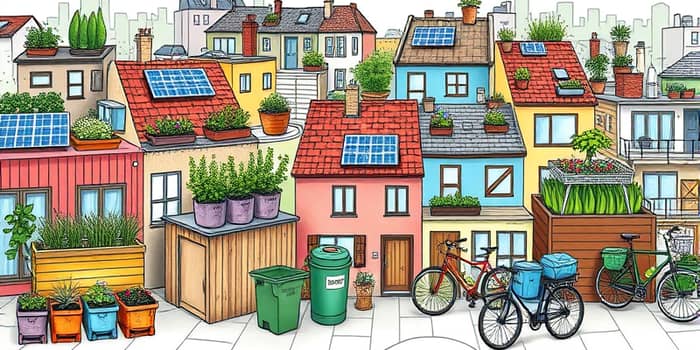
In an era of mounting environmental and social challenges, adopting resourceful living is not just an option—it’s a necessity. Climate impacts, resource scarcity, and social inequality converge to demand smarter designs and choices that benefit people and planet alike.
This article delves into the global context, consumer trends, design strategies, and policy innovations shaping a future where waste is minimized, resources are shared, and communities thrive sustainably.
By 2050, climate disruptions will reshape lives worldwide. Experts warn that without adaptation, we could face environmental shocks forcing internal displacement across regions. The World Bank and major climate accords predict a potential 4.4% drop in world GDP if sustainable practices are not embraced.
Food systems stand at the heart of this challenge. Agricultural production contributes 26% of global GHG emissions and drives 80–90% of deforestation and biodiversity loss, eroding natural buffers against extreme events.
Meanwhile, water is becoming increasingly scarce. By 2030, global demand will exceed supply by 40%, leaving nearly half the population vulnerable to shortages. These converging threats underscore why resource efficiency is no longer optional—it’s a global imperative.
Resourceful living offers resilience. From rainwater harvesting to community gardens, on-the-ground actions can reduce vulnerability and create resilient urban and rural ecosystems.
As ecological awareness grows, so does consumer demand for sustainable goods. Surveys indicate a rising willingness to support brands that align with environmental values, signaling a pivotal shift in spending patterns.
However, enthusiasm varies by region and demographic. While Gen Z and Millennials champion eco-friendly choices, older consumers often cite higher costs and limited availability as barriers.
This dynamic highlights a critical tension: demand exists, but accessibility and affordability must improve. Brands that innovate on price points and distribution can capture this growing segment while advancing resource-efficient lifestyles.
Despite broad support for sustainability, real-world challenges persist. Price premiums and limited access often position eco-friendly options as luxuries rather than staples.
Infrastructure gaps, especially in low-income areas, hinder waste reduction and recycling efforts. Only a fraction of communities benefit from organized compost pickup, deposit-return schemes, and repair networks that could extend product lifespans.
Cultural norms and knowledge gaps also shape behavior. To foster change, education campaigns must communicate not only the environmental stakes but practical steps individuals and businesses can take.
Stakeholders must collaborate to lower barriers. Governments can offer tax credits and incentives, while private enterprises can invest in scalable, low-cost green technologies that democratize access.
Intentional design lies at the core of resourceful living. By embedding sustainability into products and systems, designers can minimize waste and maximize longevity.
Circular economy principles drive system-wide reuse by keeping materials within closed loops. Examples include refillable packaging, modular electronics designed for repair, and industrial symbiosis where one sector’s byproduct becomes another’s input.
Corporate initiatives illustrate this shift. Unilever aims to cut virgin plastic use by 50% by 2025, while leading fashion brands adopt textile recycling programs. Cities integrate nature-based solutions—like green roofs and restored wetlands—to absorb stormwater and enhance biodiversity.
Transportation and water also benefit. Expanding electric vehicle infrastructure and low-emission public transit reduces carbon footprints, while smart water systems capture runoff and recycle greywater for irrigation.
Global benchmarks offer valuable lessons. The Environmental Performance Index and Sustainable Development Goal metrics reveal how some countries have built resource-efficient systems that balance economic growth with ecological health.
Beyond energy and waste systems, these nations invest in climate literacy education, health equity, and real estate incentives for energy-efficient building retrofits—creating holistic frameworks for resourceful living.
Integrating these practices locally can accelerate progress, from expanding bike lanes and green spaces to scaling deposit-return schemes that significantly cut landfill volumes.
Data underscores the magnitude of the challenge. More than 2.2 billion people—26% of the global population—lack access to safe drinking water, a crisis projected to intensify by 2030.
Achieving the Paris Accord’s 1.5°C threshold demands a 42% reduction in greenhouse gas emissions by 2030 and 57% by 2035. Yet current trajectories fall short, prompting calls for accelerated policy and investment.
Corporate action is ramping up. Nearly half of Fortune 500 companies now pledge net-zero emissions by 2050, a dramatic rise from 8% in 2020. Meanwhile, ESG-certified products drove 56% of consumer packaged goods market growth from 2018 to 2023.
Protecting 30% of terrestrial and marine environments could secure 80% of species and preserve 60% of global carbon stocks, highlighting the profound benefits of conservation-focused resource management.
Today, sustainability as a core business imperative shapes corporate strategies. Firms deploy carbon accounting tools, AI-driven supply chain optimization, and advanced building management systems to minimize waste and emissions.
Regulatory landscapes are evolving too. Governments in leading nations impose stricter waste management mandates, ban single-use plastics, and offer grants for green building retrofits and heat-pump installation.
Innovations like smart meters and digital platforms empower consumers with real-time resource-use data, fostering accountability and behavior change. In agriculture, satellite-enabled monitoring helps farmers optimize water and fertilizer use, reducing runoff and greenhouse gases.
Green finance mechanisms—such as sustainability-linked loans and carbon markets—are directing capital toward resource-efficient projects, aligning investment returns with environmental performance.
Designing for resourceful living is a collective endeavor. Policymakers, businesses, communities, and individuals must unite around shared goals to drive systemic change.
By taking concrete steps today, we can transform waste into opportunity, conserve vital resources, and foster communities that prosper in harmony with the natural world. The path to resourceful living is clear—let’s walk it together.
References