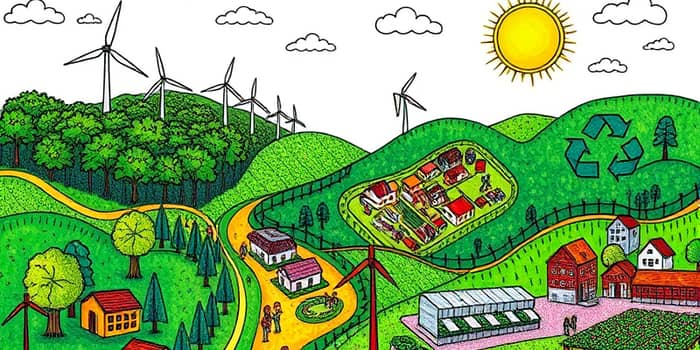
In an era of mounting environmental crises and widening social inequalities, crafting an economic model rooted in morality and long-term thinking has never been more urgent. Traditional approaches that prioritize short-term profits often sacrifice human well-being and planetary health, pushing ecosystems to the brink.
This article offers a comprehensive exploration of how an integrated moral foundation can reshape global economies. By examining definitions, core principles, real-world examples, and practical strategies, we aim to inspire readers to envision and enact a system that sustains both people and the planet.
At its core, an ethical economic framework values transparency, equity, and responsibility above mere financial gain. It challenges the assumption that economics can be value-neutral by embedding justice into every transaction, investment, and policy decision.
A sustainable economic system balances three interdependent pillars: social equity, environmental stewardship, and long-term economic viability. Instead of depleting resources for immediate returns, it prioritizes renewable practices, inclusive growth, and intergenerational justice, safeguarding prosperity for future citizens.
Understanding the foundational elements of sustainability helps organizations and governments align goals with ethical objectives. The following table summarizes these pillars with illustrative metrics and examples.
Neglecting any individual pillar undermines the entire system. True resilience emerges only when social justice, environmental health, and economic vitality reinforce one another.
Several normative commitments form the backbone of an ethical economic framework. These principles guide individual actions, corporate strategies, and government policies, ensuring that every stakeholder upholds shared values.
By embedding these values into legal frameworks, corporate charters, and civic culture, societies can shift from extractive models to regenerative ones that honor the intrinsic worth of people and nature.
Translating principles into practice requires targeted mechanisms and collaborative partnerships. The circular economy, green job initiatives, and public-private alliances offer scalable pathways to ethical sustainability.
These strategies demand continuous monitoring, transparent data reporting, and adaptive management to ensure that ethical intentions yield measurable progress and equitable outcomes.
Costa Rica has emerged as a beacon of environmental stewardship, generating over 98% of its electricity from renewable sources. Its national policies integrate conservation priorities with economic development, demonstrating that a nature-positive growth path is both feasible and beneficial.
The European Union’s ambitious Circular Economy Action Plan projects net business savings of €600 billion and the creation of 24 million green jobs by 2030. This large-scale initiative underscores how policy frameworks can accelerate innovation and resource efficiency across diverse industries.
Despite clear benefits, traditional neoclassical economics often resists value-driven reforms. Institutional inertia, vested interests, and short-term political cycles pose significant obstacles to systemic change.
To overcome these barriers, stakeholders must cultivate real-time accountability through transparent metrics on emissions, equity, and economic inclusion. Public discourse should highlight the moral imperatives of sustainability, while research must refine models that align economic growth with ecological limits.
Embedding an ethical framework into the heart of economic systems is not merely a policy choice—it is a moral calling. By fostering inclusive innovation and regenerative practices, societies can build economies that honor human dignity, nurture ecosystems, and sustain prosperity for all. The journey ahead demands collaboration, courage, and a steadfast commitment to values that transcend market cycles.
References