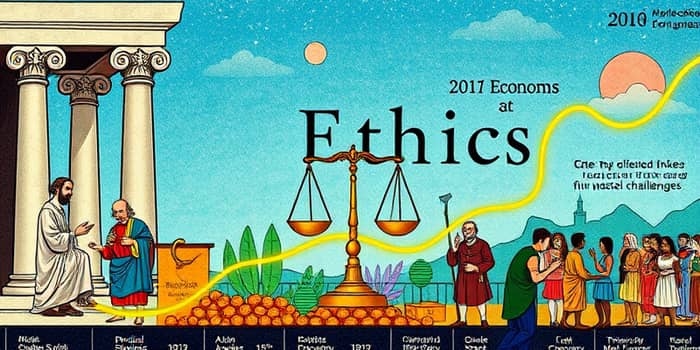
From the earliest reflections on wealth to the latest debates on sustainability, economic thought has never been void of moral inquiry. In every age, thinkers have wrestled with questions about how resources should be allocated, who deserves what, and what constitutes the good life for individuals and communities. Long before the rise of modern economics, scholars and philosophers were deeply engaged with issues of distribution, poverty, and prosperity, based on a vision of society grounded in notions of justice and fairness.
By exploring the trajectory from Plato and Aristotle to contemporary schools addressing climate change and inequality, we trace how economic theories have moved from ethical considerations toward technical abstractions—and now seek to reintegrate normative values. This journey reveals not only shifts in analytical tools, but also evolving moral frameworks that have shaped policies and institutions across centuries.
In Ancient Greece, economic thinking was inseparable from ethical philosophy. Plato, in The Republic, critiqued private property and championed the idea of common interests over individual accumulation. His proposals for collective ownership and labor specialization reflected a concern with social divisiveness, hinting at what modern scholars recognize as a credit theory of money. For him, the proper ordering of society required economic arrangements that served the whole, not just the few.
Aristotle deepened this entwinement of ethics and economics by asserting that the purpose of life is human flourishing (eudaimonia). He distinguished between use value and exchange value, condemning usury as “unnatural” because it treated money as a commodity that yields profit on its own. While he acknowledged the need for some private property, he argued that ethics demanded a just economic order as a foundation for a virtuous society.
During the Middle Ages, Christian Scholastics like Thomas Aquinas brought theology and commerce into dialogue. In the Summa Theologica, Aquinas developed principles of just price and just wage, insisting that trade and labor should reflect moral obligations and contribute to spiritual salvation. Economic life became part of a broader journey toward divine ends, with commerce regulated by ethical norms rather than pure self-interest.
The School of Salamanca further advanced these ideas in the 16th and 17th centuries by introducing communis aestimatio hominum, or public estimation of value, foreshadowing modern market considerations. Yet even as they recognized supply and demand, Salamanca thinkers maintained that market-driven prices must be judged against moral benchmarks to ensure fairness and community welfare.
From the 16th to 18th centuries, mercantilism placed the state at the center of economic life, treating national wealth and power as the highest ends. In this period, state power and national wealth often trumped ethical concerns about distribution and the well-being of ordinary people. Critics arose, however, setting the stage for proto-liberal arguments that championed commercial freedom and individual rights.
Early modern thinkers like John Locke began to shift the emphasis toward individual property and subjective value. Locke’s theories of labor and appropriation laid philosophical groundwork for utilitarian perspectives, fostering debates on how markets might responsibly serve both individuals and society at large.
Adam Smith’s magnum opus, The Wealth of Nations (1776), marked a turning point by merging moral philosophy with economic analysis. Smith argued that self-interest, guided by an invisible hand, could produce outcomes aligned with the public virtue of societal prosperity. Yet in The Theory of Moral Sentiments, he warned against the dangers of extreme inequality: “No society can surely be flourishing and happy, of which the far greater part… are poor and miserable.”
Following Smith, David Ricardo, Thomas Malthus, and later John Stuart Mill and Jeremy Bentham developed the labor theory of value, comparative advantage, and utilitarian ethics. Mill extended utilitarianism by emphasizing the quality of pleasures rather than mere quantity, adding depth to economic debates about poverty, inequality, and monopoly power.
In the 1870s, William Stanley Jevons, Carl Menger, and Léon Walras initiated the Marginal Revolution, establishing marginal utility as the basis of value. Economics became increasingly formal and mathematical, focusing on individual choice, optimization, and Pareto efficiency. Theories of market equilibrium and competition were heralded as inherently ethical, promising equal opportunity and meritocracy.
Yet this shift also drew criticism. Skeptics argued that an exclusive focus on efficiency overlooks issues of distributional justice and social welfare. They warned that a purely technical approach risks neglecting the human and moral dimensions at the core of economic life.
Karl Marx launched a powerful critique of capitalist economics by exposing the alienation and exploitation embedded in labor markets and private property. His vision of historical materialism recast economic inquiry as a fundamentally ethical and political pursuit, laying groundwork for socialist alternatives that prioritized communal welfare over individual profit.
The ensuing debate between classical liberalism and socialism has animated economic discourse ever since. Proponents of market freedom highlight prosperity and innovation, while critics underscore the moral imperatives of eradicating poverty and reducing inequality.
The Keynesian Revolution of 1936 reintroduced normative concerns by advocating government intervention to secure full employment and shared prosperity. Keynes argued that laissez-faire market forces could fail to deliver social welfare, requiring ethical judgments in policy design. Concurrently, welfare economists like Arthur Pigou and Paul Samuelson developed formal tools to analyze externalities and public goods, clarifying when markets fall short and justifying corrective measures.
Today’s intellectual landscape is marked by diversity. Behavioral economists examine how real human decisions diverge from theoretical rationality, ecological economists embed environmental ethics into resource allocation, and feminist economists highlight gendered dimensions of economic life. These perspectives collectively argue for a richer dialogue that fuses analytic rigor with moral reflection.
The following table highlights milestones that reshaped the relationship between ethics and economics over centuries:
These key events illustrate shifts in how ethical questions have been integrated—or sidelined—in economic analysis.
From ancient debates on communal welfare to modern challenges of climate change and inequality, the evolution of economic thought reveals a persistent tension between efficiency and ethics. Today, the imperative is to develop frameworks that address global challenges while honoring ethical reasoning and human dignity. By learning from diverse traditions—classical, scholastic, utilitarian, and pluralist—economists and policymakers can craft institutions that promote prosperity in concert with justice.
Ultimately, the journey ahead demands humility and creativity. Reintegrating moral discourse into economic practice can ensure that the engines of growth also serve the broader aims of human well-being, equity, and sustainability for generations to come.
References