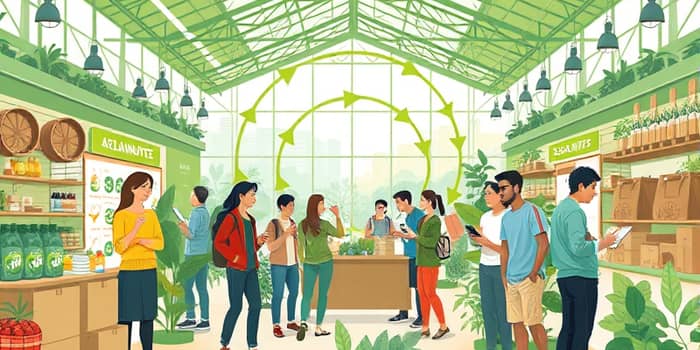
In an era defined by environmental urgency and shifting consumer values, the eco-economy has emerged as a powerful force driving design, innovation, and market growth. Businesses and consumers alike are seeking solutions that balance economic prosperity with ecological stewardship, creating a dynamic landscape ripe with opportunity and challenges.
The eco-friendly sector in the United States is experiencing remarkable expansion. American consumer spending on sustainable products is projected to reach $217 billion by 2025, up from $199 billion in 2023. This segment is growing 71% faster than conventional retail, with sustainably marketed goods accounting for 19–19.4% of total U.S. retail spending in 2024–2025. Analysts forecast this share will climb to 23% by 2032.
Globally, approximately 80% of consumers express willingness to pay a premium—typically up to 5%—for eco-friendly products. Between 2019 and 2023, the willingness to pay extra for local and ethically sourced items increased by up to 66.7%, highlighting a pronounced shift toward conscientious consumption.
Eco-conscious shopping has gained traction across generations. In 2024, 177 million Americans identified as sustainable shoppers, marking a 7.44% year-over-year increase. Each age cohort contributes uniquely to this trend:
Key motivations include improving environmental health (29%), reducing manufacturing waste (23%), and lowering personal carbon footprints (22%). Nearly half (48%) of consumers plan to avoid buying new products through upcycling or second-hand purchasing, demonstrating a pronounced shift in behavior toward resourcefulness and waste reduction.
Circular design and service-based approaches are reshaping product lifecycles. By moving from ownership to access, companies encourage repair, reuse, and responsible consumption. The five primary trends in circular design for 2025 include:
These strategies not only enhance environmental performance but also improve operational efficiency by 30–35% and provide brands with a sustainable price premium averaging 9.7%. They also mitigate supply chain risks, reducing exposure to resource scarcity by around 40%.
Material science and design are converging to produce novel, lower-impact solutions. Agricultural biomass, fungi-based mycelium, and animal by-products are replacing traditional plastics and synthetic fibers. Companies that pioneer these bio-based materials benefit from high consumer acceptance and carbon footprint reductions of up to 35%.
Packaging is undergoing a parallel transformation. Sixty percent of shoppers report willingness to pay extra for compostable or reusable packaging. Brands are experimenting with circular mailers, refillable containers, and subscription-based packaging returns to minimize waste. Electric and bike delivery pilots by major retailers illustrate how logistics can align with environmental goals.
In the built environment, regenerative architecture is gaining momentum. Designs now strive not just to reduce harm but to restore ecosystems—through green roofs, on-site renewable energy generation, and water-capture systems that support biodiversity and community well-being.
As consumer demand for accountability rises, more companies are publishing comprehensive sustainability reports. The number of brands reporting annually tripled between 2016 and 2023. Nearly half invest in post-consumer recycling programs, and 39% prioritize production efficiency upgrades. Digital transparency tools—including automated life cycle assessments and real-time dashboards—are rapidly becoming standard practice in manufacturing, driven by regulatory pressures and stakeholder expectations.
These metrics not only inform strategic decisions but also foster trust. Transparent sustainability reporting has become a key differentiator, empowering consumers to make informed choices and aligning brand values with purchasing behavior.
Innovative loyalty schemes are rewarding consumers for green behaviors. Points earned for recycling products, choosing slower shipping options, or purchasing second-hand goods can be redeemed for donations to environmental causes or exclusive eco-friendly rewards. These programs foster community and strengthen brand loyalty, turning mundane transactions into meaningful engagement opportunities.
Despite strong interest, adoption lags. While 80% of consumers say they would accept a 5% premium, actual price differentials can reach 27–30% in some categories, creating a perception gap. Economic uncertainty and inflation can shift priorities back to cost over sustainability for certain segments.
Meanwhile, just 40–60% of companies have fully embraced advanced circular strategies. Overcoming internal resistance, scaling innovations, and navigating regulatory complexity remain significant hurdles for businesses seeking to lead in the eco-economy.
The path forward offers abundant opportunities. Sustainable products are projected to capture 23% of U.S. retail by 2032, and digital data integration promises even greater optimization of resources. Generational momentum—driven by Gen Z and Millennials—will continue to reshape markets, driving demand for transparent, ethical, and regenerative offerings.
Expanding service-based and Product-as-a-Service models will unlock new revenue streams and foster deeper customer relationships. As AI and real-time analytics enhance design and supply chain transparency, businesses that integrate technology with sustainability principles will gain competitive advantage and contribute meaningfully to global climate goals.
By embracing holistic circular strategies and engaging consumers through transparent reporting and innovative incentives, organizations can build resilient, purpose-driven brands. In this evolving eco-economy, design is not just about aesthetics—it is the blueprint for a prosperous, equitable, and sustainable future.
References