Every day brings new financial and environmental challenges. Households face rising costs, economic uncertainty, and the stark reality of climate change. In this landscape, building resilience means more than saving money; it means aligning our financial health with planetary well-being.
Financial resilience is the capacity of individuals and families to withstand, adapt to, and recover from shocks such as job loss or medical emergencies. It rests on core pillars: emergency savings, manageable debt, financial literacy, access to credit, and retirement preparation.
Recent data shows that the US middle-class resilience index stood at 7.3 in Q2 2025, marking eight months in positive territory but down 21 points year-on-year due to inflation and slowing wage growth. Half of middle-class households now worry about affording daily essentials in the coming year, up from 38% in 2024.
Globally, more than 60% of people feel financially secure, yet many lack true resilience. Over half have no plan beyond a year, and only 8% project more than a decade ahead. Meanwhile, 71% could cover their expenses for less than six months if income stopped; only 45% of high-resilience individuals could last longer.
These figures underscore the crucial gap between perceived security and actual preparedness.
Here is where households stand today:
Inflation reshapes spending: 72% of households feel it most in groceries, 60% in energy, 47% in healthcare, and 42% in transport. As prices climb, 59% have trimmed non-essentials, 29% have cut essentials, and 28% have dipped into savings to meet basic needs.
In this environment, short-term priorities dominate. Managing day-to-day budgets ranks top for 60%, while emergency funds are now the second priority at 42%, surpassing retirement savings. Yet saving for retirement remains key over a 3–5 year horizon for 44% of respondents.
This shift toward immediacy can erode long-term security unless balanced by strategic planning. Households must avoid falling into a cycle of constant catch-up and instead build a financial framework that endures.
To protect both personal finances and the planet, individuals can take concrete steps:
By combining robust financial habits with sustainable choices, individuals reinforce their own stability and foster broader environmental benefits.
Systemic support amplifies individual efforts. Policymakers and institutions must design frameworks that enable resilience for all income levels.
These interventions not only protect households but also stabilize the macroeconomy by sustaining consumer spending and enabling recovery after crises.
High-resilience individuals actively seek information and professional advice: 49% pursue financial education compared to 28% of low-resilience peers, and 40% consult advisors versus fewer in less resilient cohorts. This engagement drives confidence: 83% of high-resilience people feel secure meeting short-term obligations, versus only 25% of those less prepared.
Closing this divide requires outreach tailored to diverse communities, leveraging trusted channels and creative content to demystify finance and sustainability.
Climate change poses both physical and transition risks. Property values near flood zones and wildfire areas may decline, and insurance premiums for high-risk regions can surge. Investments in fossil fuel sectors face stranding as economies shift toward cleaner energy.
Recognizing climate risk as a financial risk helps individuals and institutions retool portfolios, redirecting capital toward resilient infrastructure and green innovation.
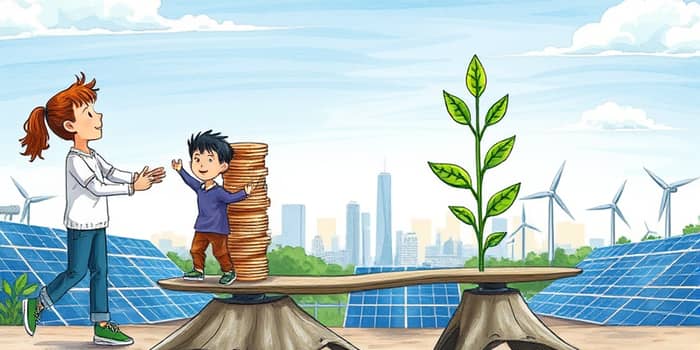
Designing for resilience demands a dual focus on personal finances and planetary well-being. By adopting strategic saving habits, managing debt, and choosing sustainable investments, individuals can fortify their economic foundations while contributing to environmental health.
At the same time, policymakers and financial institutions must enact policies that widen access to resources, education, and incentives—ensuring that resilience becomes a reality for all.
Together, through informed action and collective commitment, we can create a future where financial stability and ecological balance reinforce each other, paving the way for communities that thrive in any climate.
References